Press release
CREDIT MUTUEL VICTORIOUS IN THE BRAZILIAN HEAT
The Trojan War didn’t happen after all
A favorable Cape Horn but a laborious climb up the South Atlantic
Two duelists for a final showdown



The Trojan War didn’t happen after all
A favorable Cape Horn but a laborious climb up the South Atlantic
Two duelists for a final showdown
GLOBE40 2025/2026 – PRESS RELEASE No. 33 – February 15, 2026
CREDIT MUTUEL VICTORIOUS IN THE BRAZILIAN HEAT
The Trojan War didn’t happen after all
A favorable Cape Horn but a laborious climb up the South Atlantic
Two duelists for a final showdown
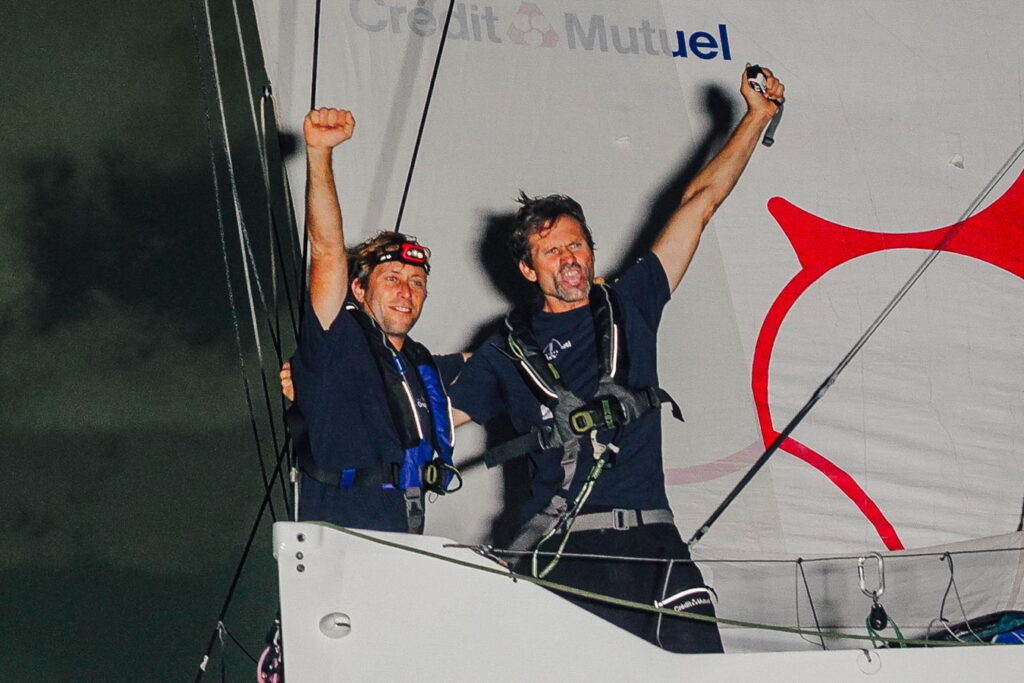
Today at 22:20 UTC, after 25 days and 5 hours at sea, and 5,898 nautical miles at an average speed of 9.7 knots, the Class40 CREDIT MUTUEL crossed the finish line in Recife as the winner of Leg 5 of the GLOBE40; the race started on February 18 from Valparaiso, Chile. A highly anticipated stage for the leaders, a chance to settle the score after the surprising tie in the previous 7,000-mile transpacific leg. But ultimately, the unfolding scenario was very different, though just as intense. A long and arduous journey northward concluded with the two contenders tied in the overall standings, leaving the final stage to decide the outcome.
The Trojan War never took place.
After a magnificent start from the legendary Valparaiso Bay, everyone expected another head-to-head battle between the two leaders: BELGIUM OCEAN RACING – CURIUM (leading by 2 points in the overall standings) of Jonas Gerckens and Corentin Douguet, and CREDIT MUTUEL of Ian Lipinsski and Antoine Carpentier. A fresh crew embarked for the leg on the Belgian boat, while on the French side, Ian Lipinski took over the helm with Antoine Carpentier, who had departed from Sydney. Facing difficult conditions right from the start, with headwinds of around thirty knots and a choppy sea, the Class40 fleet was taking a beating, as they say in sailing circles. After a few days of this ordeal, on February 23rd, the Belgian team announced significant damage (a broken mainsail track car and a damaged J1 halyard) and decided to head for the Chilean port of Valdivia, 1000 km south of Valparaiso. It was a very short pit stop, as barely five hours after docking, the Class40 was back at sea following a highly effective intervention by its technical team (Albane and Pierre) and, as always, a superb welcome from the local Chileans. But meanwhile, CREDIT MUTUEL was taking advantage of very favorable weather and pulled ahead, leaving both the classic, high-performance Class40s in a calm zone and the Belgian team struggling to get back on its original course.
The Cape Horn baptism of the GLOBE40 2nd edition.
On February 26th, CREDIT MUTUEL rounded Cape Horn with a lead of nearly 600 miles in unusually favorable conditions in this equally legendary area; two more Cape Horners, an unforgettable experience for each, a step in an offshore racing career, and a personal achievement. On February 28th and March 1st, the other six Class40s rounded Cape Horn in quick succession, within 12 hours, a first experience for all but Melodie Schaffer and Paul Stratford (WHISKEY JACK) and Rupert Holmes (JANGADA RACING). But after rounding Cape Horn, things looked very different: a few days later, north of the Falkland Islands, a violent low-pressure system from the Andes Mountains struck the crews. Then followed, for almost two weeks, a complex succession of windless zones, virtually unpredictable weather, and the constant search for a breath of wind, with the eternal choice between heading for the coast and going out to sea. What a long and difficult journey up the South Atlantic it was! Especially since the further north they sailed, the more the heat became stifling, even oppressive, past Cape Frio.
An unfinished comeback and the duelists heading towards a final showdown.
“Comeback” is indeed the appropriate term when you consider that CREDIT MUTUEL’s maximum lead of 612 miles over BELGIUM OCEAN RACING – CURIUM at Cape Horn was reduced by 6:00 AM on March 11th to… 12 miles. Favorable weather and the skippers’ skill—the exact proportions are not scientifically known, but what an adventure! This comeback was thwarted one night by a fishing net while sailing up the coast of the state of Pernambuco. An unexpected hour-long swim, a weakening wind, and the French team was once again flying ahead with an average lead of around fifty miles, which the two skippers managed to maintain. Meanwhile, the “pointus” (traditional boats) remained very close, within a hundred miles, choosing a more offshore option. FREE DOM took the lead after a bowsprit failure on BARCO BRASIL hampered them for several days. WILSON, always excellent, grew bolder, aiming for a podium finish and perhaps even the lead among the narrowest boats, while JANGADA RACING and WHISKEY remained closer than ever, ready to seize any opportunity within the group. This group was slowly making headway upwind in light winds, expecting a bunch finish on the mornings of March 18th and 19th.
BELGIUM OCEAN RACING – CURIUM, 80 miles behind the French team, is expected to arrive late tonight. The Belgian team’s anticipated second place, barring any unforeseen circumstances, and today’s French victory have resulted in a tie between the two leaders at 19 points, a tie that should be confirmed by the race committee.
Reminder of the ranking system and the coefficients/distance for each leg.
Points: 1st place receives 1 point, 2nd place 2 points, etc. The total number of points is multiplied by the coefficient per stage.
Coefficients per stage and theoretical distance:
– Prologue: 0.5 (900 miles)
– Leg 1: 1 (1500 miles)
– Leg 2: 3 (7050 miles)
– Leg 3: 2 (5120 miles)
– Leg 4: 3 (6390 miles)
– Leg 5: 2 (4860 miles)
– Leg 6: 2 (4290 miles)